

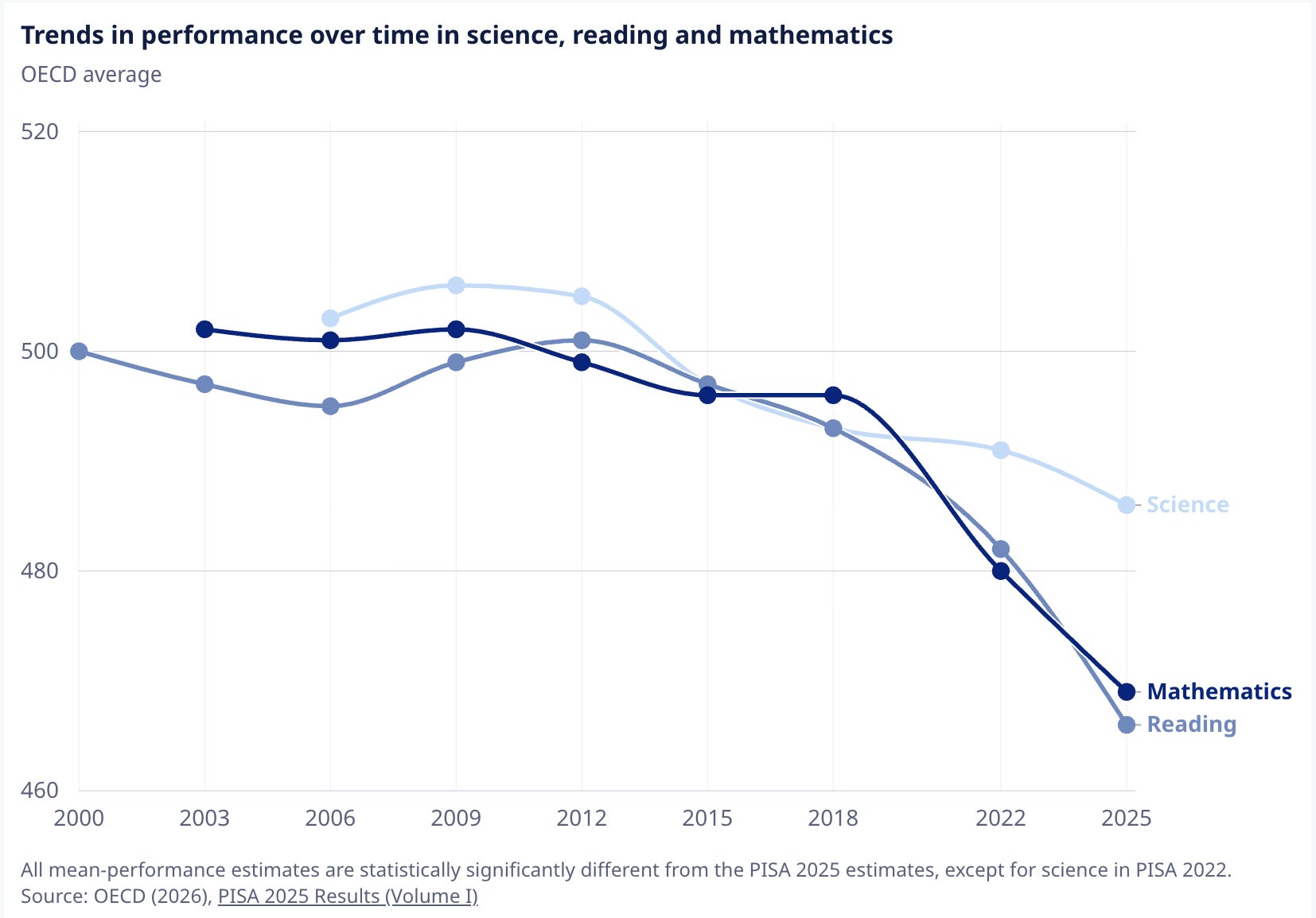
This morning I read through the latest PISA results (an international test of 15 year olds in maths, reading and science) and it has to be said that the headline findings are grim. Especially for reading.
The blame will inevitably fall on screens and the Pandemic but increasingly this doesn’t add up. If it were all down to the screens then you have to account for the fact that Singapore has among the highest smart-phone saturation in the world but also the highest reading scores. You also have to explain that if it was the Pandemic, why scores haven’t recovered by now.
In the technical annex of the report, the collapse in reading seems to be disproportionately concentrated in the tasks that require sustained reading of long text, and this reveals a fundamental cultural shift. We are seeing a generation of kids who are not “less cognitively capable” but rather one raised in a culture of skills-based reading which implicitly told them that what you read is less important than how you read it.
The results are in and they’re not good. For those of us in England, it’s pretty clear now that the Nick Gibb led reforms based on systematic phonics, a knowledge rich curriculum and explicit instruction have yielded strong results in reading. England are one of the few developed countries not to show a decline and the contrast with neighbouring Wales and Scotland strengthens that case.
But the global direction of travel is very concerning. It’s customary to blame the Pandemic for a lot of what’s gone wrong in education but the decline had started well before that. Reading scores started to tank around 2012 and the general direction of travel point toward some uncomfortable truths about cultural shifts in reading and attention and that policy will not be able to fix.
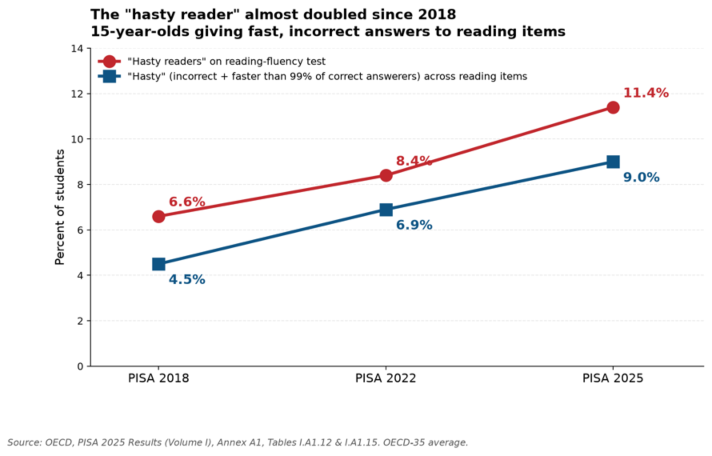
There was one finding however that I found particularly interesting and it’s a measure called the ‘hasty reader’ which describes students who make more than one error on the opening reading fluency task and then complete it faster than 99 per cent of accurate readers in the same country and language group. I think this metric, perhaps more than any other, is very revealing about why we are where we are in 2026 with reading.
“Hasty reading” doesn’t mean kids who read quicker or students who get wrong answers but rather a kind of deadly combination of the two. It means students who are giving answers to questions that they haven’t really spent enough time on to answer them correctly or accurately. (This I think raises massive questions about the validity of PISA assessments but that is for another day.) It says a lot about what kids value as much as their ability to focus.
A poor reading of this will be some version of the ‘kids today’ argument which will take a behavioural measure and pathologize it onto ‘kids cant concentrate any more because screens’ or they all have “TikTok brain” and cannot concentrate on anything for more than 2 seconds. This might be true at some level but the hasty reader metric cannot tell you that because it’s a measure of behaviour not a brain scan.
What it can tell you however is that a particular strategy has become very common now with 15 year olds: scan and skim for a plausible answer, click and then on to the next question. Rinse and repeat.
Interestingly, this behaviour seems to have now generalised. Between 2018 and 2025, scores on the reading test declined the most on test items which used longer source texts (evaluate and reflect tasks) and ones with simple MCQs. Hasty responses are also evident in the Maths test where there is a paragraph setting up a problem.
For me, this is what you get when you base a whole educational model on skills rather than knowledge. If what you are reading is less important than how you read it, then the act of reading becomes a procedure to be executed on whatever happens to be in front of you.
For decades now, the way in which we have taught kids to read, (and the way in which we have taught teachers to teach kids how to read) has been defined by a set of nameable, transferable strategies or skills in which the reader is encouraged to use the question stem to skim for the ‘main idea’, scan for key words, infer meaning, and ‘compare and contrast themes’. Is it any wonder then that we have cultivated a generation of “hasty” readers?
None of this will surprise anyone who has engaged with the reading literature of the last twenty years. In Reader, Come Home, Maryanne Wolf made the claim that the human disposition of deep-reading is something established and sustained by a culture not determined by our biology and that it ultimately fades under conditions which rewards the kind of reading defined by rapid, associative scanning.

The alarmist view emerging is that children are today are dumber, that they are now “less cognitively capable” than previous generations and that screens are to blame. For me this view is not only reductive, but also takes us further away from solving the problem. Brains don’t change in a generation, environments do.
I have three girls who are all probably reading less than I was at their age but they are just as “cognitively capable” as I was, if not more. What’s different today is the competition. When I was a kid, there was no Internet, no Playstation and the TV had four channels with little of interest for me. I turned to books not because I was more cognitively capable, but because I was bored.
But blaming screens for the decline of reading makes little sense either and I’m as guilty as anyone for reaching for the easy explanation. First the construct of ‘screen-time’ itself doesn’t really mean anything. At least not as an explanatory variable. Two hours reading ‘Great Expectations’ on a kindle is about as far away as you can cognitively get from two hours doom-scrolling on TikTok but yet both are lumped into the same category, aggregated and then correlated with a range of negative outcomes from brain-fog to depression.

The focus on skills sees reading as a generic transferable strategy where ‘finding the main idea’ is the goal. When generic skills are the dominant metric then the texts becomes a secondary consideration, merely the substrate in which the plants of ‘evaluation’, ‘comparing’ and ‘inference’ are seeded and grown.
Under this model, ‘Frankenstein’ and a four paragraph article about KPop Demon Hunters become interchangeable. Texts are chosen to create those generic skills and so we regrettably, we have shifted more and more towards a reading culture of extracts and compressed reading.
But reading comprehension is not predominantly a skill, it is the visible layer of a much deeper set of competencies based on domain knowledge, reading fluency and I would argue, a set of cultural and environmental norms which value sustained attention to particular texts.
One thing we do know is that we are asking a lot less of our students in terms of reading. The reading level of most texts assigned to students in the UK and Ireland secondary schools is often years below the chronological age of the students reading them. In the US, College professors have been sounding the alarm for a while now. Nicholas Dames (Columbia Literature Humanities) reports that a first-year student in Fall 2022 told him her public high school had never required them to read an entire book from beginning to end. Just excerpts, poetry, and articles.
In a new commentary on the PISA results, the Economist asks whether kids are getting dimmer. Again I find myself irritated with this lazy, alarmist analysis which obscures the larger issue that reading, as a form of sustained attention with significant cultural expression rather than a set of generic skills to be deployed on generic texts, has become a devalued commodity for kids because we tacitly told them so. No wonder they’re so hasty to get through it all.
This is a really good post. I think that the focus on teaching skimming and scanning “skills” deserves the same debunking that happened for three-cueing with beginner readers. It’s a waste of instructional time and likely more counter productive - as you explain - than helpful.
Interestingly, it seems to be a leftover from the speed-reading craze of the 1950s and 60s which was mostly based on pseudoscience.
It's right to look at the collapse of long-text reading, but these statistical measures fail in their causal priors. The hasty reader metric could record a lack of ability or a a disposition of strong disinterest in boring texts. It fails to distinguish "can't" from "won't."
The evidence provided here seems to support the "won't" abduction. A KPop article vs. Frankenstein is a difference in interest not ability. Now, if you say kids in the past read when they were bored, I'd say not so. Bored kids were channeled into things that interested them outside of schools. We don't do that now.
The real questions. Did great books ever interest most young people? Among the demographics that were interested in the past, why aren't they interested now? Can pedagogy make uninterested young people into interested readers?
It's more comfortable for educators to blame skills. It's what they believe they teach. It's hard for educators to understand that education is as much a matter of taste as of skill. And matters of taste probably can't be taught.